// article
Bob Ross by the Numbers
Every Bob Ross painting, by the numbers
The Joy of Painting ran 403 episodes across 31 seasons, and a tree showed up in 361 of them, 90 percent. Before Bob Ross reached for a mountain or a lake or the sky, he reached for a tree. FiveThirtyEight coded every episode element by element, and the table tells you what a Bob Ross painting actually is when you average all of them together.
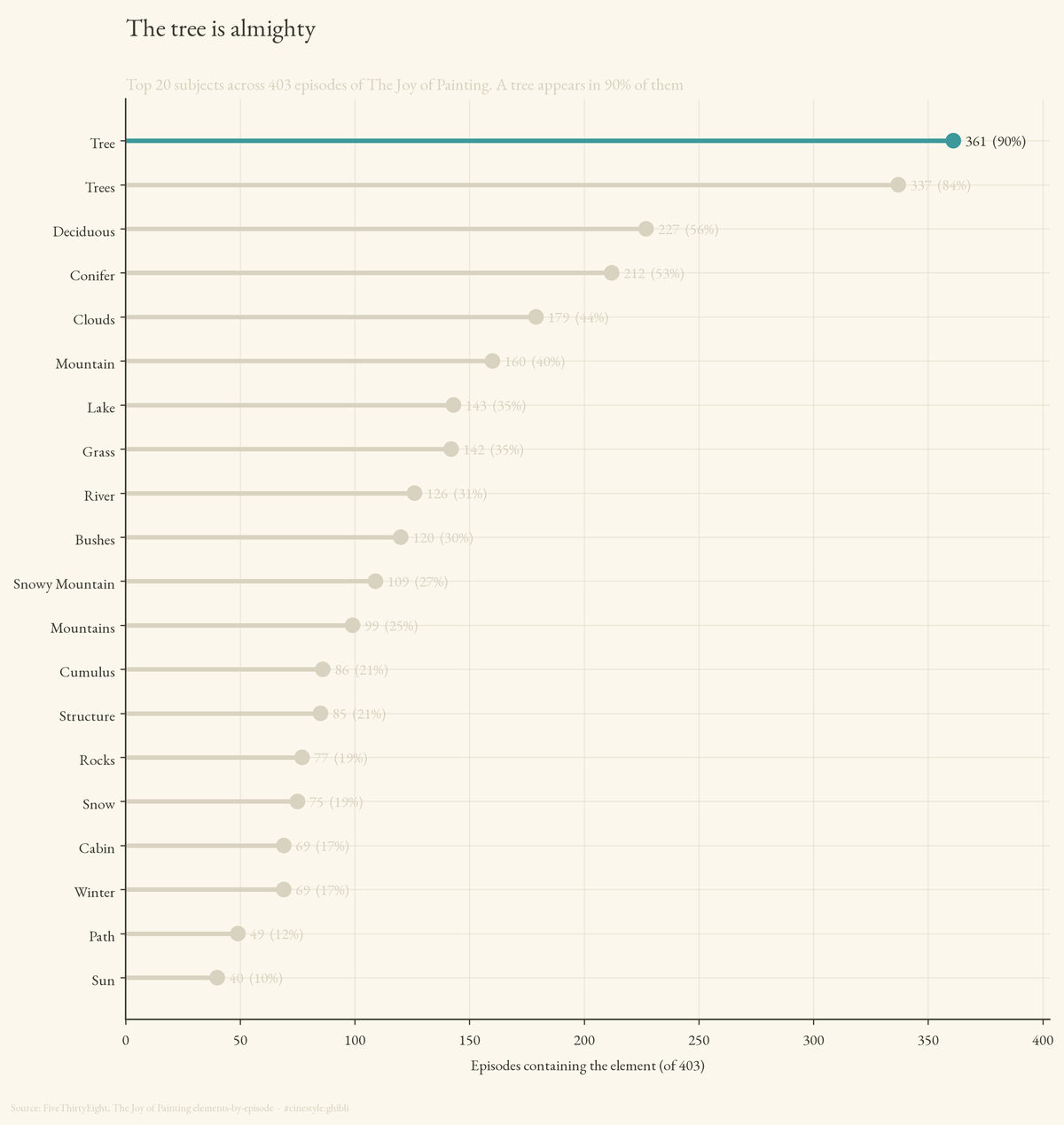
The tree is the single most reliable fact in the dataset. Tree and trees sit together at the top, and the drop to the next subject, deciduous trees at 227, separates the one habit from everything else.
The data is one row per episode and a binary column per element: did this painting contain a tree, a mountain, a cabin, snow. I dropped the sixteen frame-marker columns, which describe the canvas shape rather than the scene, and the three painter-credit columns for the episodes Bob did not paint himself. That leaves 48 painted subjects to count. The guest episodes stay in the counts, so “every episode” here means every episode of the show, not every painting by Bob.
The almighty tree
A tree appears in 361 of 403 episodes. Plural trees appear in 337. The detail I checked twice: not one episode painted trees without also painting a tree. The plural is never solo. When Bob added a stand of trees, a single tree was already on the canvas, which fits how he taught it, one happy little tree first, then its friends.
Deciduous and conifer trees follow at 227 and 212 episodes. Then clouds at 179, a mountain at 160, a lake at 143. The shape of a default Joy of Painting canvas falls out of these counts: trees in front of a mountain, water below, a sky above. Forty-two episodes have no tree at all.
Painted once, and never again
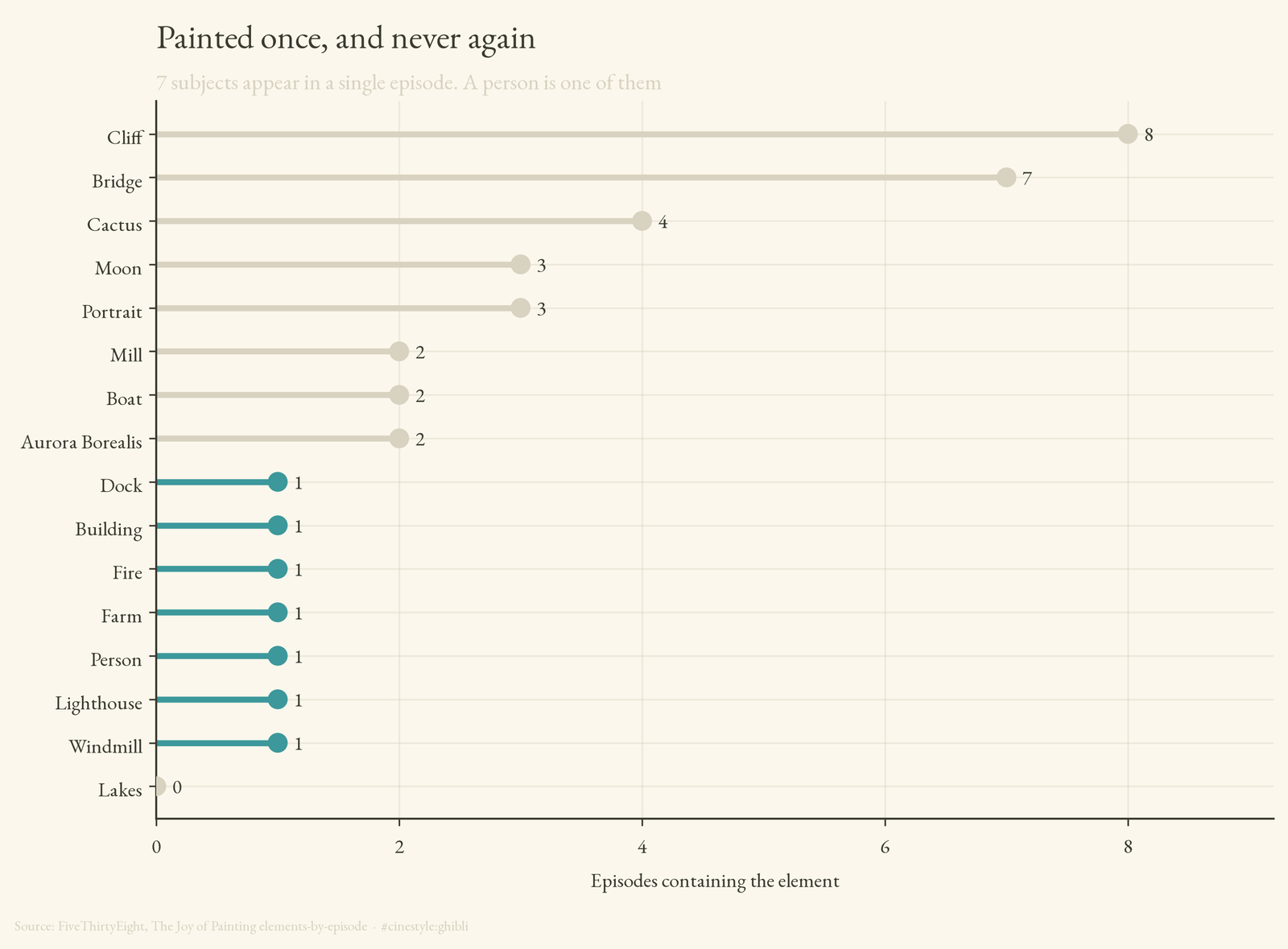
Seven subjects appear in exactly one episode each: a building, a dock, a farm, a fire, a lighthouse, a windmill, and a person. In 403 episodes, a human being appears on the canvas once. The show that put a tree in 361 episodes painted a single person and never came back to it.
Structures fare a little better. A cabin, a barn, some kind of built thing shows up more often than a person, with the generic structure tag on 85 episodes, about 21 percent. But the rare end of this chart is mostly the human world. The counts show a wilderness with the people left out.
What travels together
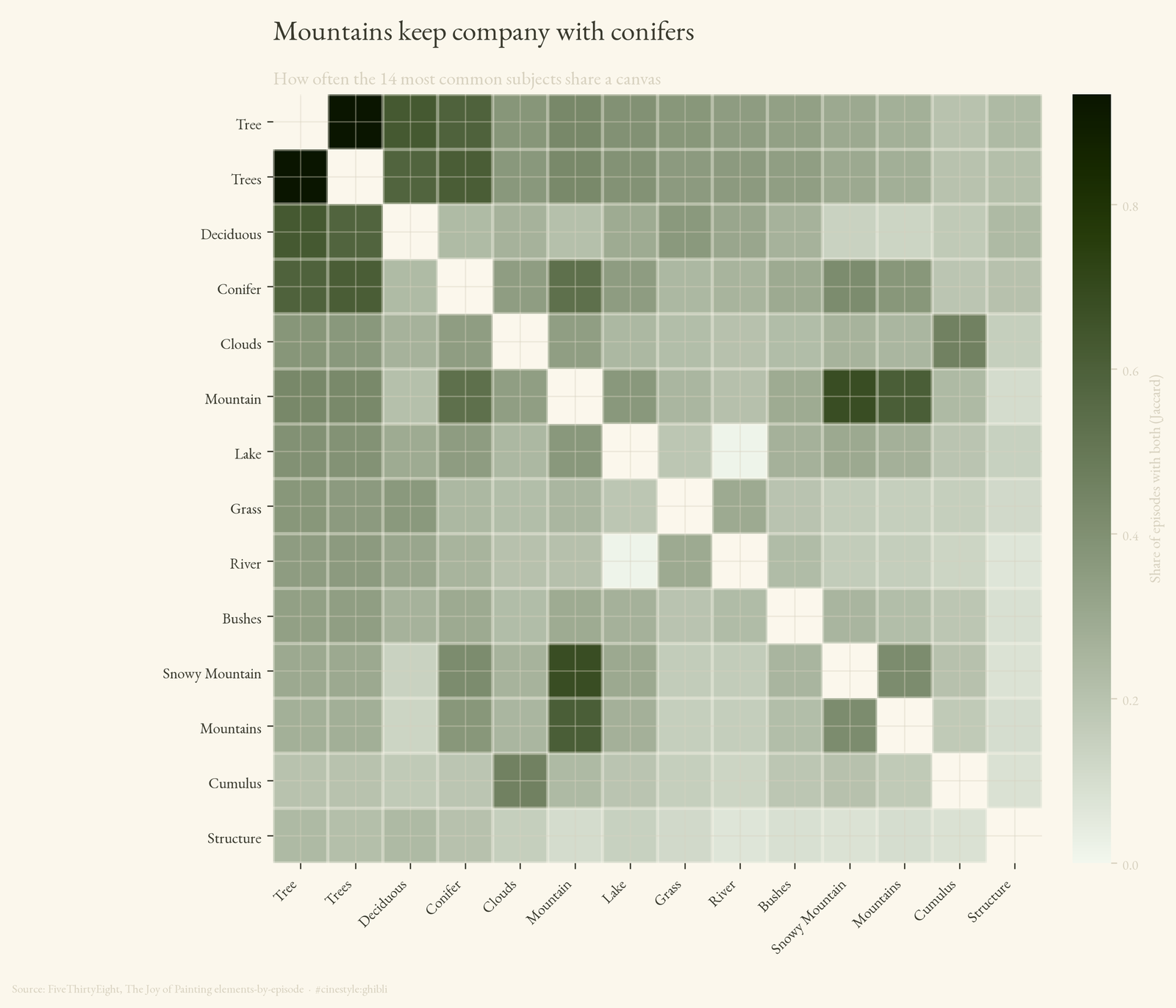
Elements do not arrive at random. Picture the canvas filling in: once a mountain is there, the rest of the scene is half-decided. Of the 160 episodes with a mountain, 81 percent also have a conifer, against a 53 percent base rate. A conifer is 1.5 times more likely to share a canvas with a mountain than chance would put it there. Lakes follow mountains too, at a lift of 1.43.
The folk wisdom is that mountains bring snow, and here the data corrects me. A snowy mountain travels with a mountain: 68 percent of mountain episodes have one. Plain snow does not. Snow appears in 18 percent of mountain episodes and 19 percent of episodes overall, which is no relationship at all, a lift of 0.97. The snow on a Bob Ross mountain is part of the mountain, painted into the peak, not weather falling on the scene. The almighty tree keeps the best company; the mountain keeps the most predictable.
The trees stay, the skies clear
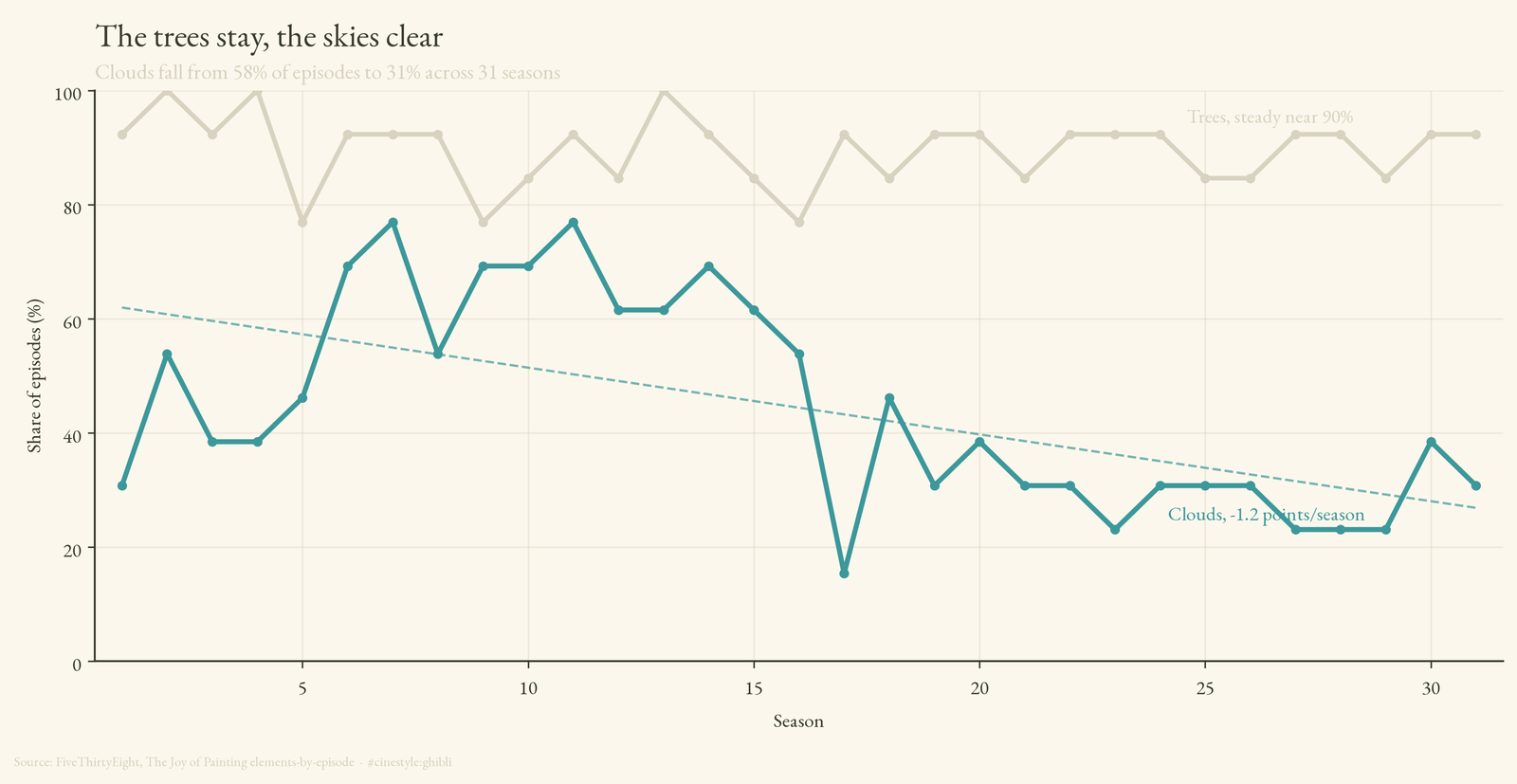
Across 31 seasons the catalogue of subjects barely moves. A tree is in 90 percent of the first fifteen seasons and 89 percent of the last sixteen. The tree rate did not drift. Whatever else changed about the show, the tree was load-bearing from the first episode to the last.
One subject does move. Clouds fall from 58 percent of early episodes to 31 percent of late ones, a decline of about 1.2 percentage points per season. The correlation with season number is only -0.21, so this is a gentle trend in noisy data, and clouds are the only element I tested for it. I do not have a tidy reason for it, and I will not invent one. The skies in the later seasons are simply emptier. The trees held; the weather thinned out.
I started this expecting a tree count and a list of favorites. I found a show whose entire run resolves to one habit it almost never skipped and one nobody noticed leaving. The tree never left; the clouds did.