// article
Reading Diamond Prices
The best-cut diamonds are the cheapest, and other lies the data tells
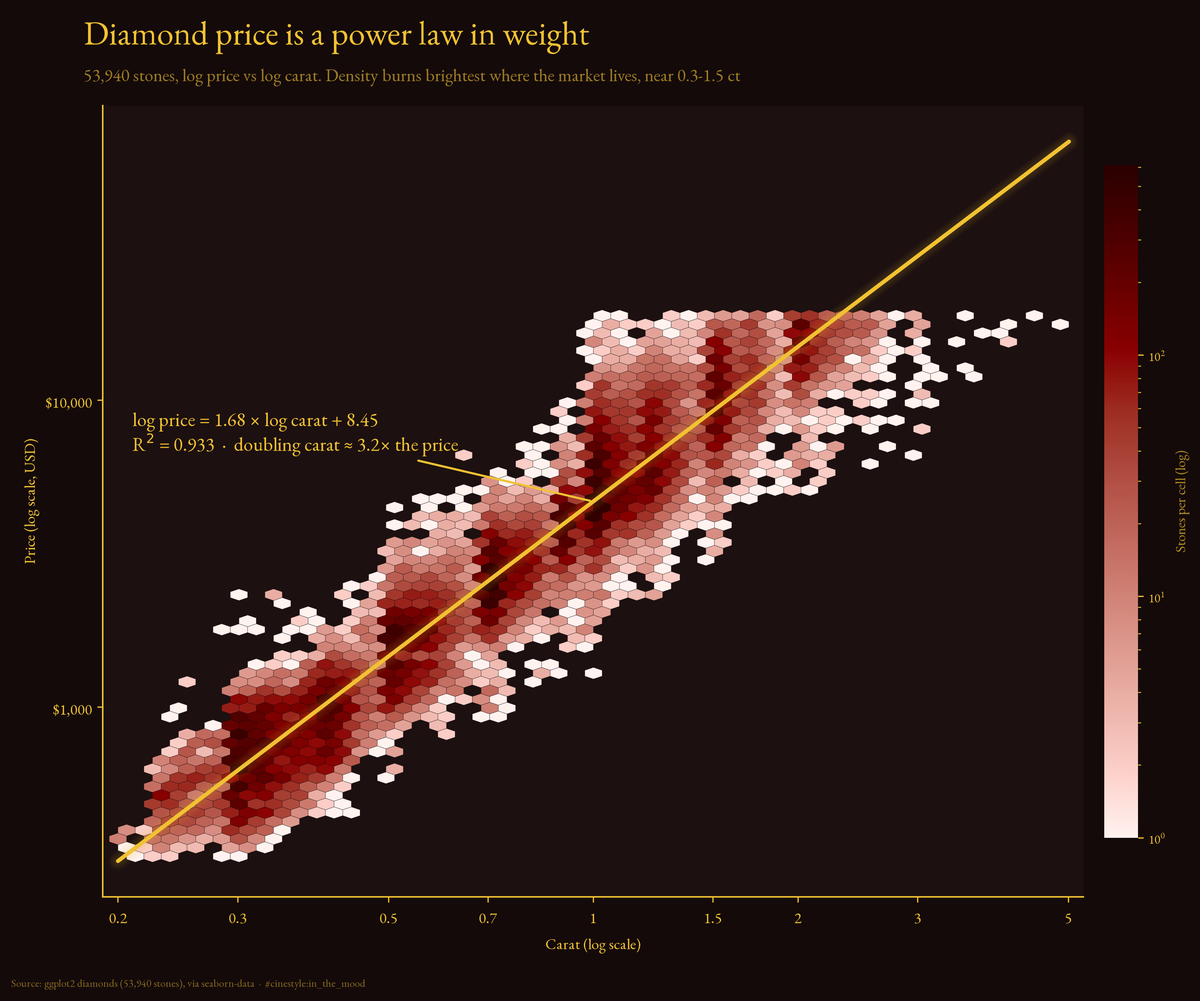
A diamond’s price is almost entirely its weight. Bin all 54,000 stones by log carat and log price and the cloud collapses onto a single straight line: one variable, log-transformed, pins down 93% of the price. Everything else in this post is a footnote to that line.
Pull up the diamonds and group by cut. Ideal stones, the top grade, have a median price of $1,810. Fair stones, the bottom of the barrel, sit at $3,282. So the worst-cut diamonds cost almost twice what the best-cut ones do. The number is real and misleading, and it is the most useful wrong answer in the dataset.
The data is the ggplot2 diamonds set, 53,940 stones, loaded through the catalog (source: ggplot2 diamonds, via seaborn-data). Ten columns: carat, cut, color, clarity, price, the x/y/z dimensions, and the depth and table proportions. It is a listing snapshot with no documented collection date, and the prices are nominal, with no inflation adjustment and no transaction confirmation. Treat the dollar figures as relative, not as what you would pay today.
Price is lopsided; carat is lumpy
Start with the two distributions, because they set up everything else. Price runs from $326 to $18,823 with a mean of $3,933 and a median of $2,401. When the mean sits 64% above the median, you are looking at a long right tail, and the skew confirms it at 1.62. Take logs and it nearly vanishes: skew of log price is 0.115, basically symmetric. That is the first hint that the rest of this should happen in log space.
Carat is the stranger picture. Plot it in 0.01-carat bins and it is not a smooth slope, it is a comb. There are spikes at the round numbers, 1.0 and 1.5 and 2.0, with dead zones just below them. About 7.2% of the stones (3,902 of them) land exactly on a half-carat mark: 0.5, 1.0, 1.5, and so on. That is not how a physical quantity distributes itself.
The 1-carat line is the clearest tell. There are 1,558 stones at exactly 1.00 carat. In the nine hundredth-bins just below it, from 0.90 to 0.99, the average bin holds 304 stones. So the 1.00 bin is 5.1 times denser than its neighbors. The bin right under the line, 0.99 carats, holds only 23 stones.
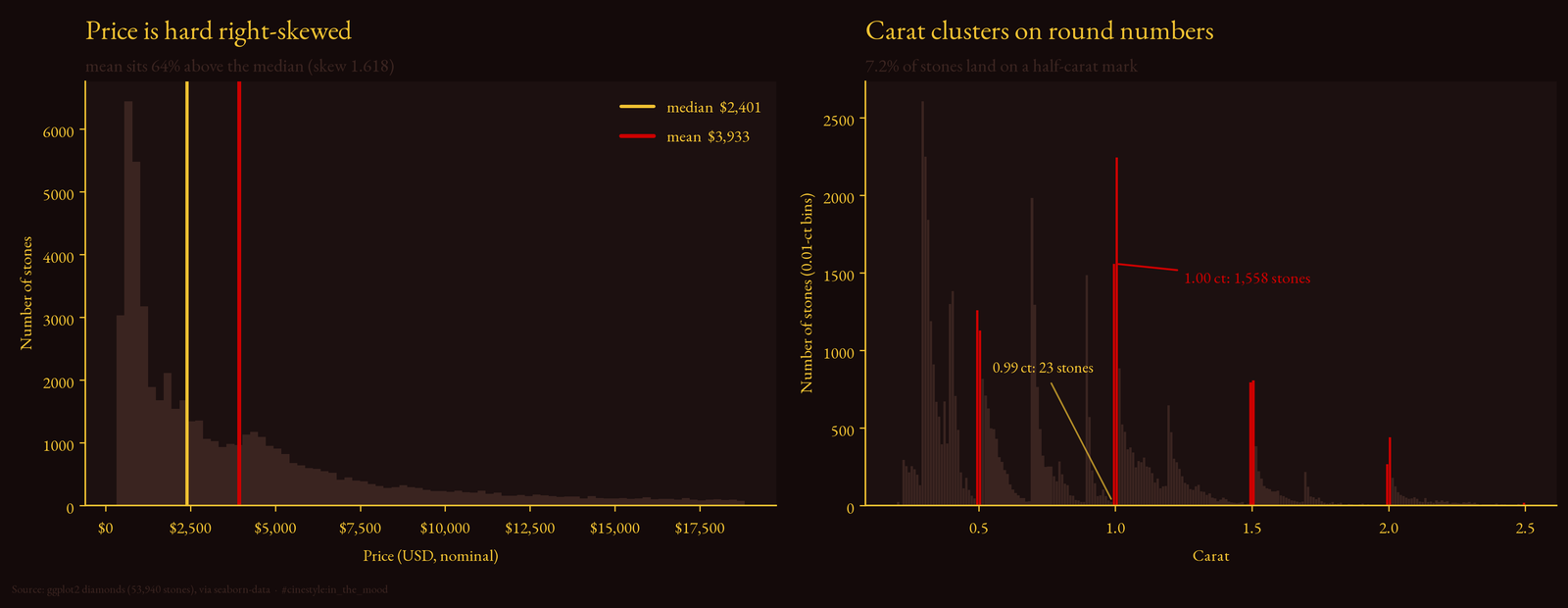
A 1-carat stone clears a psychological price wall that a 0.99 does not, so cutters leave a sliver of rough on rather than drop under the line, and some stones that come out at 0.99 may be rounded up when listed. The spike is a property of people, not carbon.
Price per carat is not a price per carat
The phrase “price per carat” implies a constant, a unit rate. It is not one. Divide price by carat, bin by size, and the median rate climbs the whole way up. A 0.2 to 0.4 carat stone runs about $2,241 per carat. By 1.0 to 1.2 carats it is $4,951. By 2 to 3 carats it is $7,177, which is 3.2 times the rate of the small stones.
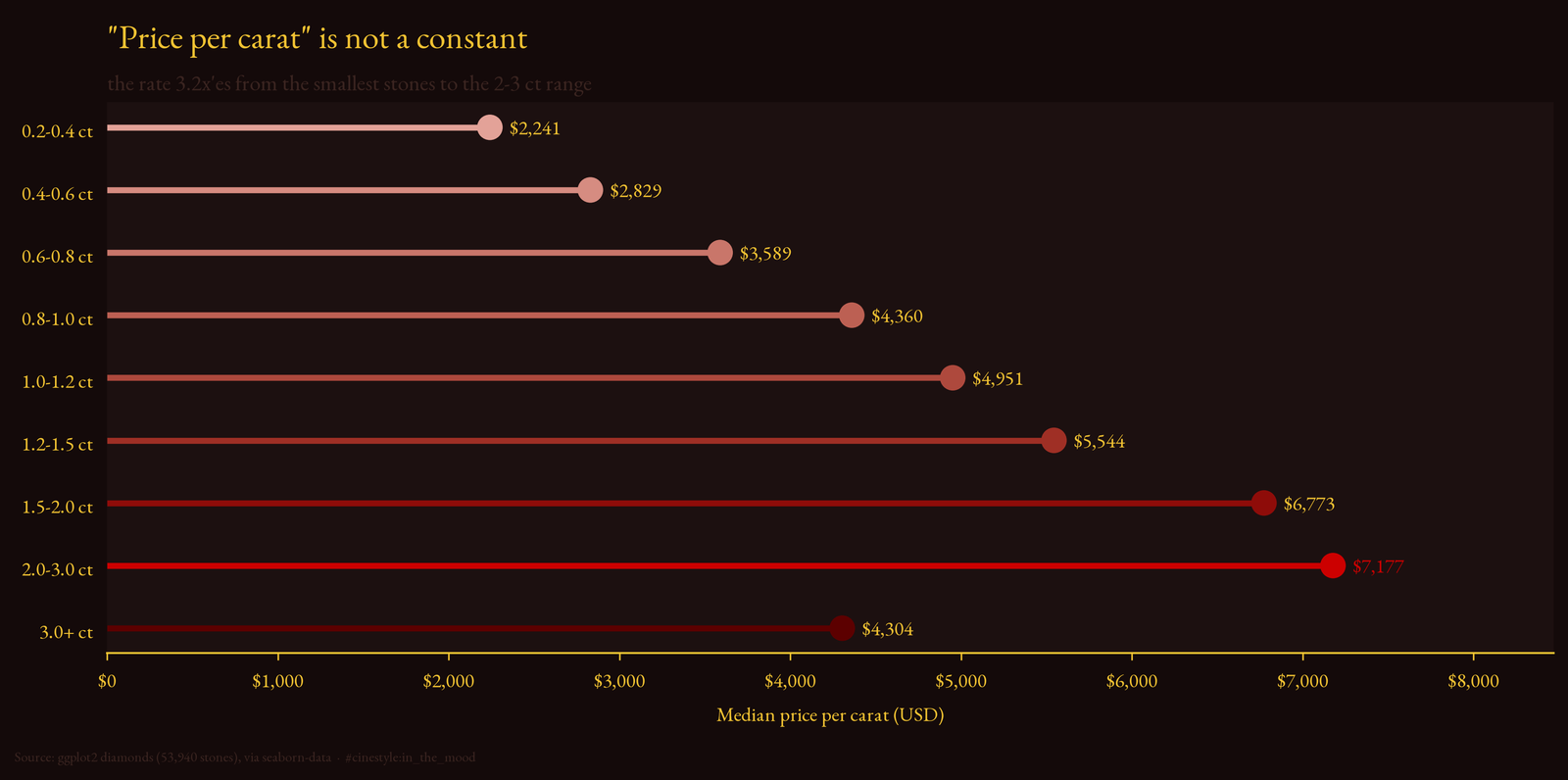
So a 2-carat diamond costs more than twice a 1-carat, because each carat is also worth more. Picture the rough as a quarry: the big clean blocks are far rarer than the gravel, and rarity compounds. The one place the curve bends back down is the 3.0+ bin ($4,304/ct), and I would treat that as thin tail noise. Those are the few dozen monsters where color and clarity vary wildly, not a real reversal.
Back to the cut paradox
Now the opening number makes sense. Ideal diamonds are cheaper because they are smaller. Median carat by cut: Ideal 0.54, Premium 0.86, Fair a full 1.00. My guess is that stones cut for maximum sparkle give up weight, while stones cut to keep weight give up the grade, but the data only shows the tangle, not the reason. The cut column and the carat column move together, and carat wins the price fight every time. Cut never lowered the price; it was standing in for size.
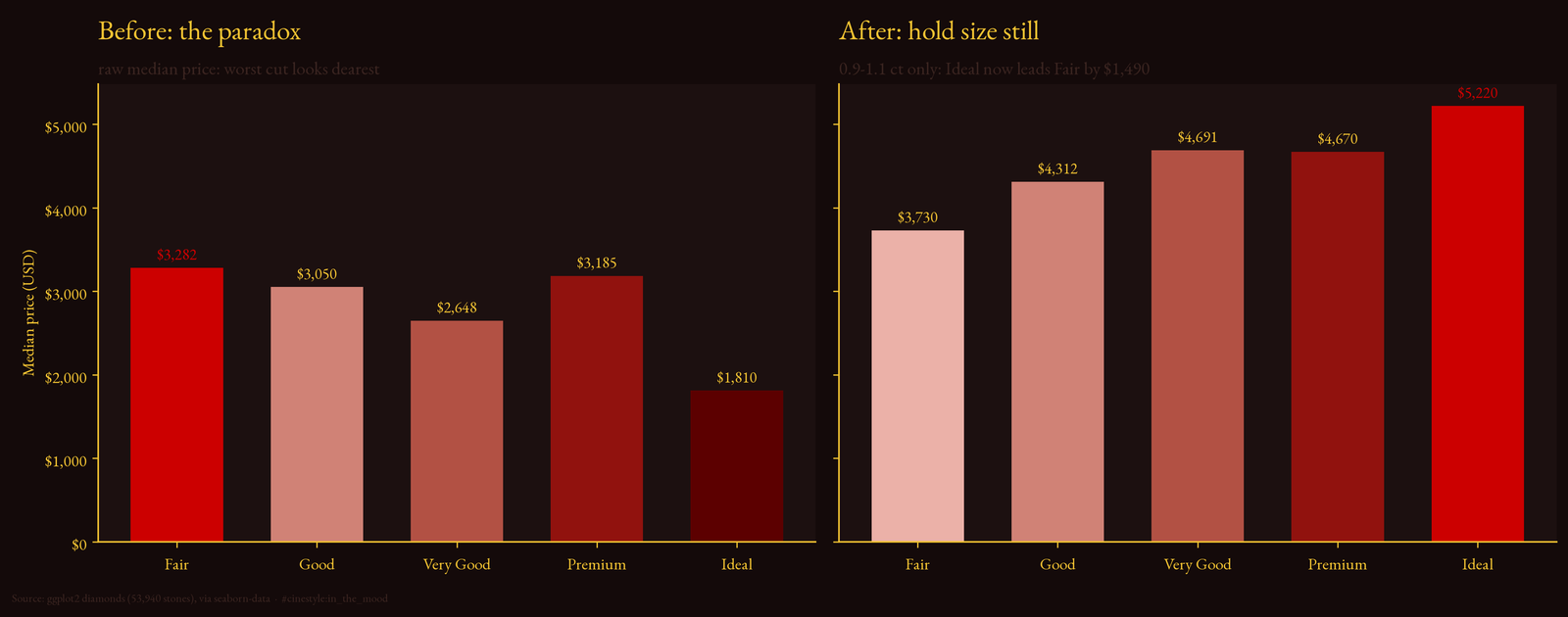
Hold size still and the illusion flips. Inside the 0.9 to 1.1 carat band, where every stone is about the same weight, Ideal cuts median $5,220 and Fair cuts median $3,730. Same size, better cut, $1,490 more. Cut does what you would expect once you stop letting carat impersonate it. When a raw average disagrees with the controlled one, trust the control.
The line that explains 93% of it
Throw the categories out and fit the one relationship that matters: log price against log carat, straight OLS. The slope is 1.68 and the R-squared is 0.933. One variable, log-transformed, accounts for 93% of the variance in log price across 54,000 stones. Color, clarity, cut, the three dimensions, everything else is fighting over the last 7%.
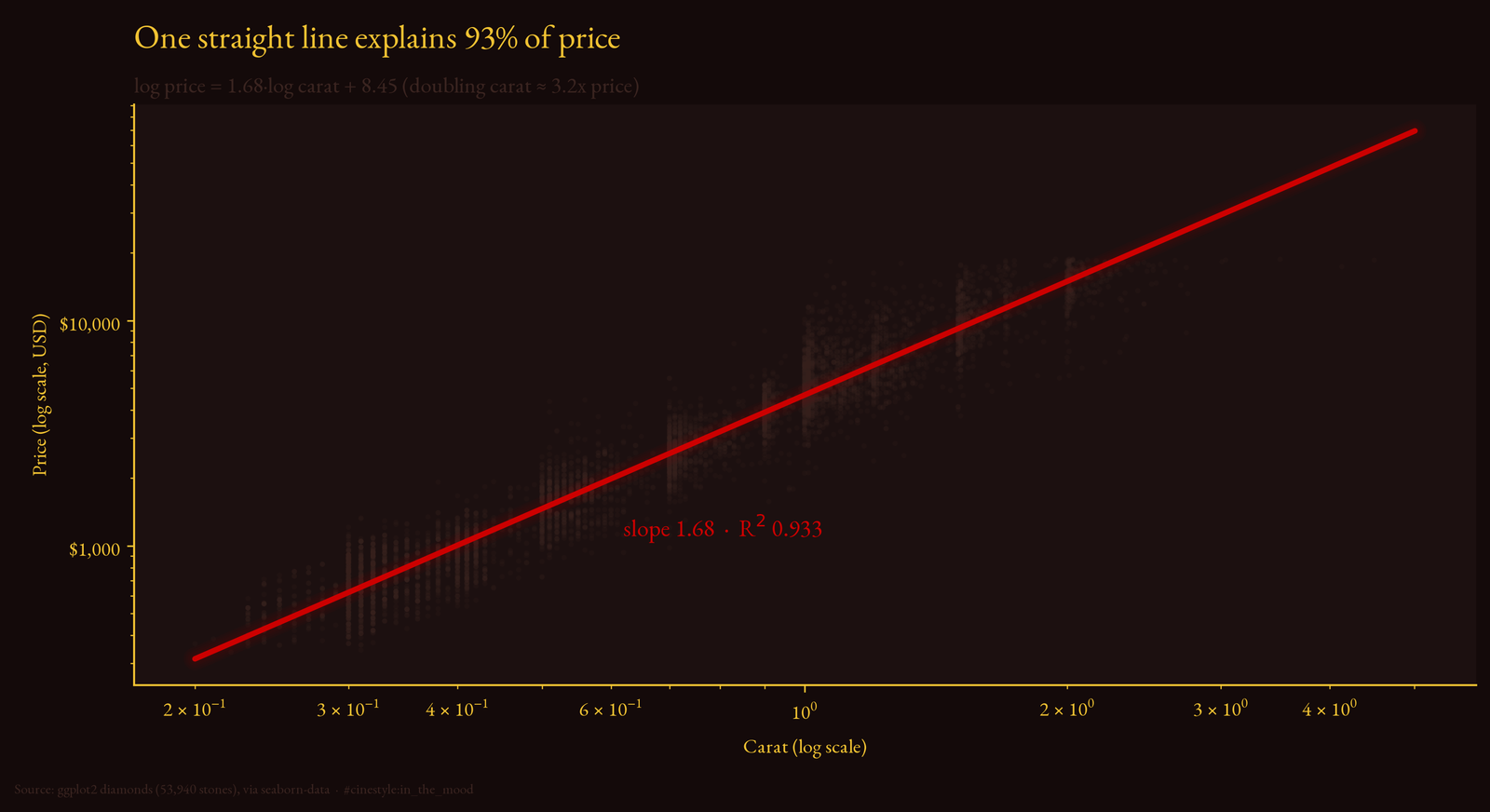
A slope of 1.68 is the rising-rate story in one number. If price scaled linearly with weight the slope would be 1.0. At 1.68, doubling the carat multiplies price by about 3.2, so the per-carat rate has to climb with size, which is what the binned curve shows. The 3.2 in the per-carat section is a different ratio, between the 0.2 to 0.4 bin and the 2 to 3 bin, and the match is a coincidence.
What stays with me is the 0.99-carat hole. Most of this dataset behaves like physics: rarity, weight, a clean power law. But that gap just under 1 carat is pure human flinching at a round number, sitting in a column that is supposed to measure a rock.